Safety and Tolerability of Subcutaneous Methotrexate in Routine Clinical Practice
Results: In the present study, 8,394 patients received DMARDs, with 2,093 patients receiving oral MTX and 949 patients receiving SC MTX. The median dose was 15 mg (interquartile range [IQR] 10-20 mg) for oral MTX, and 20 mg (IQR 15-25 mg) for SC MTX (P < 0.0001). Continuation rates were higher for SC MTX therapy when adjusted for follow-up duration, with a rate ratio (RR) of 1.54 (95% confidence interval [95% CI] 1.40-1.70) (P < 0.0001). For the time period assessed, 2,382 patients experienced 4,358 adverse events, with 1,711 incidents of transaminitis and 2,647 incidents of neutropenia recorded. Significantly fewer adverse events were observed in patients who received SC MTX monotherapy versus those who received biologic and combination DMARD therapies (P < 0.01). Compared to oral MTX, SC MTX was associated with a nonsignificant trend toward lower rates of neutropenia, but only a slightly higher rate of transaminitis (RR 1.26 [95% CI 1.07-1.48]) (P = 0.006), despite significantly higher doses of MTX.
Conclusion: Subcutaneous MTX is safe in routine clinical practice. This is the largest study yet reported on SC MTX and provides observational data that SC MTX is continued longer and better tolerated in patients compared to other therapy groups, especially oral MTX.
Osteoporos Int. 2021 May;32(5):805-816.doi: 10.1007/s00198-020-05743-z. Epub 2020 Nov 18.
Speak UP MTX
Methotrexate and rheumatoid arthritis associated interstitial lung disease
Abstract: Question addressed by the study: Methotrexate (MTX) is a key anchor drug for rheumatoid arthritis (RA) management. Fibrotic interstitial lung disease (ILD) is a common complication of RA. Whether MTX exposure increases the risk of ILD in patients with RA is disputed. We aimed to evaluate the association of prior MTX use with development of RA-ILD.
Answer to the question: Our results suggest that MTX use is not associated with an increased risk of RA-ILD in patients with RA, and that ILD was detected later in MTX-treated patients.
Abstract: In early 2020 the new respiratory syndrome COVID-19 (caused by the zoonotic SARS-CoV-2 virus) spread like a pandemic, starting from Wuhan, China, causing severe economic depression. Despite some advances in drug treatments of medical complications in the later stages of the disease, the pandemic’s death toll is tragic, as no vaccine or specific antiviral treatment is currently available. By using a systems approach, we identify the host-encoded pathway, which provides ribonucleotides to viral RNA synthesis, as a possible target. We show that methotrexate, an FDA-approved inhibitor of purine biosynthesis, potently inhibits viral RNA replication, viral protein synthesis, and virus release. The effective antiviral methotrexate concentrations are similar to those used for established human therapies using the same drug. Methotrexate should be most effective in patients at the earliest appearance of symptoms to effectively prevent viral replication, diffusion of the infection, and possibly fatal complications.
Efficacy of methotrexate in reducing the risk of bone erosion in patients with rheumatoid arthritis: a systematic review of randomized controlled trials
Abstract: Even though new drugs for the treatment of rheumatoid arthritis (RA) have been developed, methotrexate (MTX) remains a commonly used drug for RA management. In addition to monitoring disease activity during RA treatment, bone erosion should be closely assessed throughout long-term RA management. In this review article, we present a systematic review of MTX effectiveness in reducing the risk of bone erosion. We reviewed randomized controlled trial studies that involved MTX monotherapy or MTX in combination with placebo. Evaluation of the progression of bone erosion was examined by radiographic assessment such as total Sharp score (TSS) or van der Heijde score (SvdH or vdH TSS), joint space narrowing (JSN), erosion score (ERO), and proportion of radiographic nonprogressors. Several key factors were found to influence the response to MTX treatment, such as gene polymorphism. The exact mechanism of the prevention of bone erosion by MTX remains unclear, which warrants future investigations. The variability of RA disease activity in study subjects resulted in variations in the results reported by individual studies. Collective analysis suggests that MTX could slow down the progression of bone erosion based on a radiographic score of less than 0.5-1/year.
Osteoporos Int. 2021 May;32(5):805-816. doi: 10.1007/s00198-020-05743-z. Epub 2020 Nov 18.
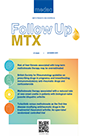
Follow UP MTX
Does methotrexate influence COVID-19
infection? Case series and mechanistic data
Conclusion: These clinical and experimental data indicate that methotrexate has certain protective effects on SARS-CoV-2 infection via downregulating ACE2.
- Risk of liver fibrosis associated with long-term
methotrexate therapy may be overestimated
- British Society for Rheumatology guideline on
prescribing drugs in pregnancy and breastfeeding:
immunomodulatory anti-rheumatic drugs and
corticosteroids
- Methotrexate therapy associated with a reduced rate
of new-onset uveitis in patients with biological-naïve
juvenile idiopathic arthritis
- Tofacitinib versus methotrexate as the first-line
disease-modifying antirheumatic drugs in the
treatment of rheumatoid arthritis: An open-label
randomized controlled trial
Set / 2023
Follow Up MTX
Para garantir uma melhor experiência ao utilizador, usamos cookies e armazenamos informações no seu computador. Algumas delas são essenciais para garantir o melhor desempenho deste site. A sua informação será processada anonimamente. Poderá encontrar as informações gerais acerca de dados pessoais na nossa Declaração de Privacidade, onde a qualquer momento, poderá alterar as suas configurações de cookies.
Aqui poderá escolher as suas preferências. Clique nas diferentes categorias para saber mais. Tenha em atenção que bloquear alguns dos cookies poderá afetar a sua experiência na internet.
Estes cookies permitem-nos verificar as suas escolhas enquanto navega. Por exemplo, podemos armazenar a sua localização geográfica numa cookie, de modo a ser possível mostrar-lhe o website consoante a sua localização.
Performance cookies are used to understand and analyze the key performance indexes of the website which helps in delivering a better user experience for the visitors.
Analytical cookies are used to understand how visitors interact with the website. These cookies help provide information on metrics the number of visitors, bounce rate, traffic source, etc.
Advertisement cookies are used to provide visitors with relevant ads and marketing campaigns. These cookies track visitors across websites and collect information to provide customized ads.
Sem estes cookies, o website não poderá realizar algumas funções básicas. Estes poderão ser definidos automaticamente quando as páginas estão a ser carregadas ou após a solicitação do utilizador que não pode ser atendida sem o uso do cookie.